Analog trigger modes have been around ever since oscilloscopes were introduced.
Besides letting you stabilize repeating waveforms in an oscilloscope-like display, analog trigger mode in data acquisition is especially important to study sudden change of an analog signal
What are the traditional analog trigger modes?
In traditional data acquisition devices, one can find the following common analog trigger modes:
- Rising edge trigger mode, which is also called positive slope trigger: Trigger happens when the signal passes a trigger level while it is rising
- Falling edge trigger mode, which is also called negative slope trigger: Trigger happens when the signal passes a trigger level while it is falling
- Above Level trigger mode: Trigger happens simply when the signal is above a trigger level.
- Below Level trigger mode: Trigger happens simply when the signal is below a trigger level
Problems with traditional trigger modes
Case : We have a slow moving sine wave, swing from rail to rail, but once a while there is a glitch riding on it. Now we need to catch the glitch and study it.
Since the waveform is swinging from rail to rail, none of the traditional analog trigger modes can catch it.
Solution
Analog Derivative Trigger Mode©.The solution is in
According to Wikipedia:
In calculus (a branch of mathematics) the derivative is a measure of how a function changes as its input changes. Loosely speaking, a derivative can be thought of as how much one quantity is changing in response to changes in some other quantity; for example, the derivative of the position of a moving object with respect to time is the object's instantaneous velocity.
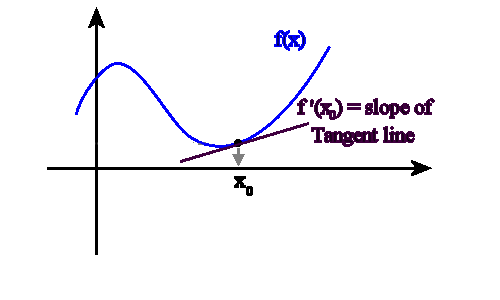
By monitoring the first-order derivative of an analog signal, we can trigger on the sudden change of a waveform!
Although the first order of derivation is described as df/dt, in practice of data acquisition, since dt, which is the inverse of sample rate, is always the same during the session, we can simply substitute df/dt with df and monitor the change of df continuously.
- If the signal is relatively clean or the change rate is not too small, a simple two-point difference is enough. This method is demonstrated in the youtube video below.
- If the signal is noisy and the change rate is small, linear-regression instead of two-point difference is necessary to warranty a real trigger. In this case, a FPGA or a high-power DSP will be the perfect candidate for the job when high-speed operation is required.
For easily implementation, we choose two-point difference in the following solution to trigger on a relatively strong glitch.
To try out this feature, you can
- Order any WinDaq-based data acquisition deivices from DATAQ Instruments, even a WinDaq Starter Kit
- Install WinDaq Acquisition software
- Install WinDaq Add-on.
- Run WinDaq
- Start WinDaq->View->Add-ons->Advanced Trigger Excel links
- Enter the equations shown below for a simple two-point derivative to capture sudden changes that are higher than 1V.
- Apply a rail-to-rail 1Hz sine wave to the inputs
- Create a glitch and watch for the trigger
Last update: 01/29/24
Copyright: 2000-20
10 www.UltimaSerial.com